Replication Guide
SQDR consists of the Replicator Service and its web client, the Data Replicator Manager. The Replicator Service is the replication engine: it holds the replication metadata (sources, destinations, subscriptions, groups and schedules) in its control database, and runs snapshots, baselines and the apply of captured changes, independently of the client. The Data Replicator Manager defines and monitors replication on one or more Replicator Services.
For ODBC destinations, the Replicator Service writes the data itself. For Java connector destinations (Snowflake, Databricks, BigQuery, Microsoft Fabric, Kafka, Amazon S3 Tables), it passes the data to Apply extensions, which write it (see ODBC and Java connectors).
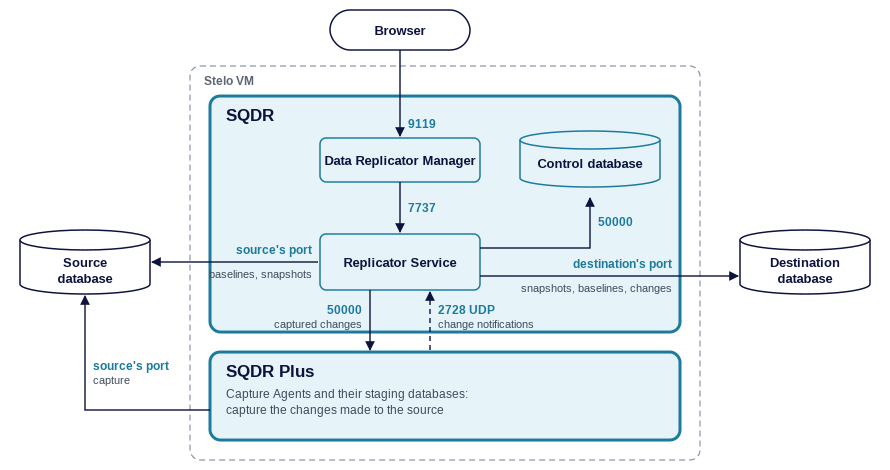
The usual setup: both parts of SQDR on one server, the Stelo VM (they can also run on separate servers). The ports are the defaults; the source's and destination's ports depend on the database (see Ports).
Capturing the changes is in the Change Capture Guide (Stelo Capture), and what each database needs is under Databases.
Related
- Databases: setting up each database, and connection strings
- Where to look: checking that replication is healthy
- Designing groups and Best practices
- Set up incremental replication (SQDR)