About SQDR
SQDR (Stelo Quick Data Replicator) keeps your analytics platforms and other databases in step with the databases that run your business. It copies your tables once, then delivers every committed change as it happens, so reports, data platforms and applications work with current data, without nightly batch loads.
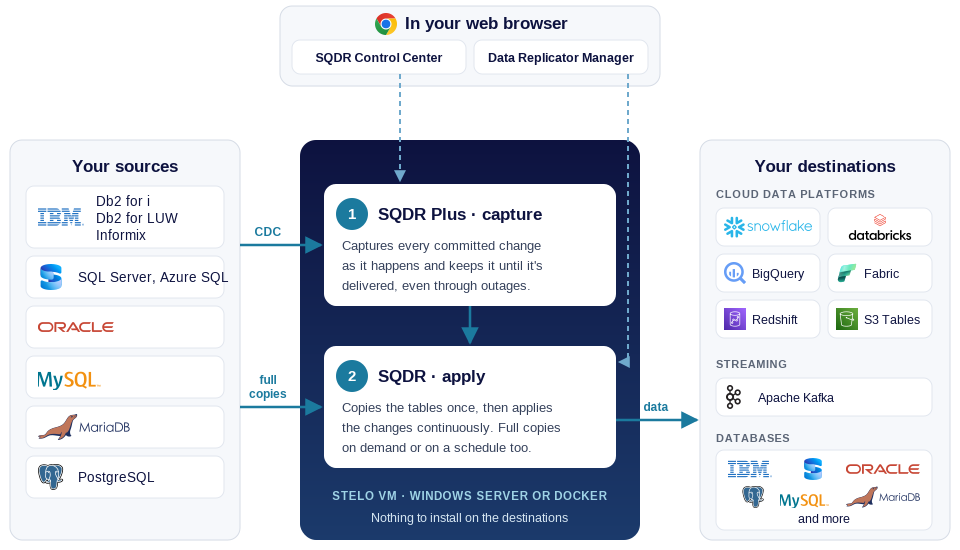
What it does
- Continuous replication. Each change committed on a source database is captured as it happens and applied to the destination, consistent at transaction boundaries.
- From the databases businesses run on. IBM Db2 for i, Db2 for LUW, Microsoft SQL Server and Azure SQL, Oracle, MySQL and MariaDB, PostgreSQL and Informix.
- To where the data is needed. Cloud data platforms (Snowflake, Databricks, Google BigQuery, Microsoft Fabric, Amazon Redshift, Amazon S3 Tables), Kafka, and the same databases as the sources, in any combination: Db2 for i to Snowflake, SQL Server to Oracle, Oracle to PostgreSQL.
- Full copies too. Tables that don't need to be current can be copied in full, on demand or on a schedule.
- Shaped on the way. Choose the tables, columns and rows to replicate, rename them, and add derived columns; data types are mapped to the destination for you.
Two parts, one server
SQDR has two parts that work together, usually on one server, the Stelo VM: a Windows Server virtual machine or a Docker container dedicated to replication.
Stelo Capture captures the changes. It reads each source database's own record of changes (its log, journal or change tracking) rather than querying your tables, so it adds little load to the source. It keeps the captured changes until they've been delivered: if a destination or the network is down, the changes wait, and replication resumes where it stopped.
Stelo Apply delivers the data. It copies each table to the destination once, then applies the captured changes continuously. It connects to the databases with standard drivers and connectors: nothing is installed on the destinations.
You set up and monitor both in your web browser: Stelo Apply in the Data Replicator Manager, Stelo Capture in the SQDR Control Center. Email notifications tell you when something needs attention.
Why SQDR
- Your data stays with you. SQDR runs on your own server, on premises or in your cloud account. The data goes straight from your sources to your destinations; it never passes through a Stelo service.
- Anywhere to anywhere. One product for any combination of supported sources and destinations, on premises or in the cloud: keep copies current, stream changes to Kafka, or move a database to a new platform.
- Light on production systems. Changes are read from the database's log or journal, not by querying your tables, and the destinations need no SQDR software.
- No programming. You choose the tables, columns and rows, and how they're mapped, in your web browser; there are no pipelines or scripts to write and maintain.
- Picks up where it stopped. After a destination outage, network failure or maintenance window, replication resumes from its last checkpoint, without copying the tables again.
- More than 30 years with IBM i and Db2. Capture from Db2 for i journals, including remote journals, multimember files and independent ASPs, and from Db2 for LUW, next to the other major databases.
- Support from replication specialists. The support team works with mixed source and destination combinations every day; annual subscriptions include 24/7 support for urgent incidents.
Where to go next
- Build my setup guide: every step of your setup, for your databases, in one page.
- Databases: every source and destination, with its drivers.
- Requirements: what you need before you install.